Abbey of San Pietro al Monte
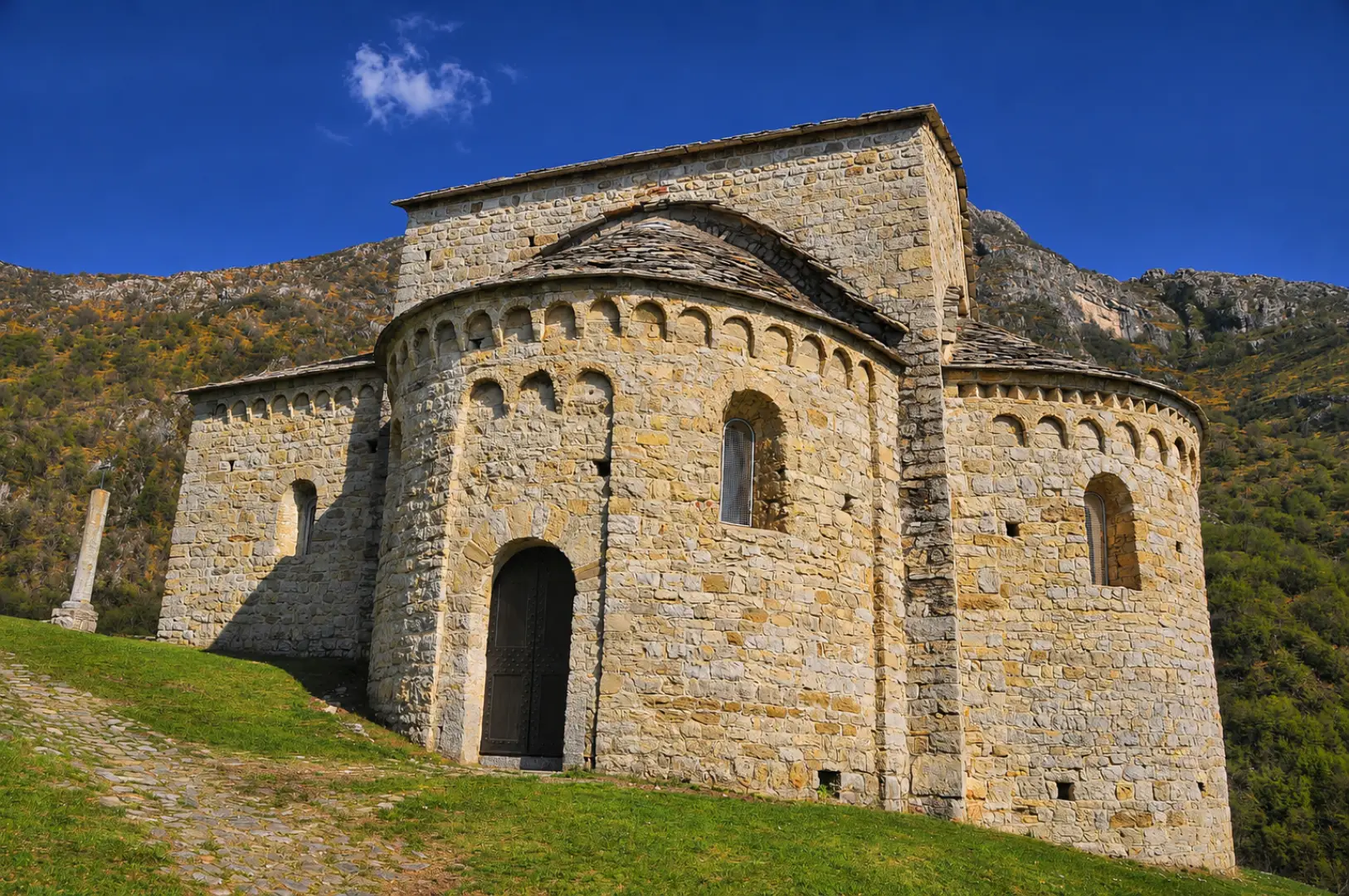 Photo by
Massimo Martini ©2014

Edited by:
Massimo Martini
Access
Access
The complex can only be reached on foot: there are no roads leading to the basilica and the access paths are not suitable for cycling. The nearest point accessible by car is the car park on Via Valle dell’Oro, in Civate, at the start of footpath 10.
Route description
At the Civate exit of the , heading towards Civate, Oggiono and Bellagio, continue straight on until the roundabout and take the second exit. Turn right onto Via Provinciale, go straight through the next roundabout and, at the third roundabout, take the third exit, joining the (0.6 km). Continue along Via Papa Giovanni XXIII for 260m (0.9km); at the roundabout, take the second exit onto Via San Paolo for 250m (1.1km) and continue along Via Bellingera for 140m (1.3km). Turn right onto Via Baselone and, after 260m, turn left to stay on Via Baselone (1.5km): the road bends to the left and becomes Via Valle dell’Oro. The car park is on the left after 600m (2.1km).
Car park
On Via Valle dell’Oro, use the free 🅿️ car park on a dirt track, just a few metres from the start of Trail 10. On public holidays, spaces may run out: alternatively, use the free 🅿️ car parks in the hamlet of Pozzo, on Via del Pozzo, Via del Rii, Via Cerscera and Via Abate Longoni. On public holidays and busy days, the 🅿️ car park on Via Baselone is reserved for coaches.
Access by public transport
Travel to Civate station, on the Como–Lecco line, served by Trenord trains on the S7 Milan–Molteno–Lecco line and the R18 Como–Molteno–Lecco line (R18 timetable). From Lecco and Como, you can alternatively take the C40 bus, alighting at the ‘Civate Paese Municipio’ stop. From the station and the centre of Civate, walk to the car park on Via Valle dell’Oro and the start of trail 10.
Access on foot
from the car park on Via Valle dell’Oro car park, via trail | San Pietro al Monte Abbey, from the car park on Via Valle dell’Oro
Distance and walking time
🕒 journey time: 34 minutes from the junction with the Milan North Ring Road
📏 Distance: 39.6 km from the junction with Milan’s northern ring road
GPS navigation
Important information
The directions provided were verified on the date the route was mapped. Before setting off, we recommend checking for any changes to the route or road conditions. For up-to-date information, please consult Google Maps or Apple Maps.
Introduction
The Abbey of San Pietro al Monte is a Romanesque-era Benedictine monastic complex in the municipality of Civate, in Lombardy, on the eastern slope of Monte Cornizzolo, within the Valle dell’Oro. The complex occupies a grassy plateau accessible only on foot, from which the view extends over Lake Annone, Mount Barro and Mount Resegone. It comprises three distinct elements: the basilica dedicated to St Peter, the oratory of St Benedict and the ruins of the monastery. The first documented mention of the monastery dates back to 845. The basilica preserves a cycle of frescoes and stuccoes dating from between the late 11th and early 12th centuries, based on the theme of theApocalypse. Since 2016, the complex has formed part of the serial nomination “The cultural landscape of the Benedictine settlements in medieval Italy”, included on Italy’s Tentative List for UNESCO World Heritage status alongside seven other Benedictine settlements.
Description
The complex stands above the village of Civate, at the end of the cobbled mule track that winds up the Valle dell’Oro. In historical literature, it also appears as San Pietro al Monte Pedale, named after the hill on which it stands. The monastery was linked to the church of San Calocero, in the centre of Civate, which gradually assumed the role of principal abbey seat during the 11th century.
Its origins date back to the second half of the 8th century. Local tradition attributes its foundation to the Lombard king Desiderius, who is said to have had the church built to fulfil a vow made for his son Adalgiso, who was blinded during a hunting expedition and subsequently healed. The first documentary reference dates from 845: the *Liber viventium Fabariensis*, compiled at the monastery of Pfäfers in what is now Switzerland, mentions the monastery of Clavades amongst the communities spiritually linked to that institution. The text lists 35 monks led by Abbot Leutgario and the priest Ildemaro, author of a commentary on the Rule of Saint Benedict dictated at Civate. In the 9th century, Angilbert II, Archbishop of Milan, who held office from 824 to 859, oversaw a renovation of the monastery; he is also credited with transferring the relics of the martyr Calocero from Albenga to Civate.
Between the 10th and 11th centuries, the complex took on the layout that is still largely recognisable today: the current entrance, with its grand staircase and semi-circular pronaos, was opened, and the Oratory of St Benedict was built. In 1162, during the conflict between Frederick Barbarossa and the Lombard communes, the abbot sided with the emperor; following the imperial defeat, the Milanese destroyed the monastery’s residential buildings in retaliation, sparing only the church, which continued to serve its religious purpose. Between the 13th and 14th centuries, the monastery fell into decline and in 1484 it was placed under commenda. In 1555, the Olivetan monks took up residence there, but were expelled in 1798 following the suppression decreed by the Cisalpine Republic. In the nineteenth century, the bell tower outside the church was demolished. Since 1975, the conservation of the complex has been overseen by the ‘Amici di San Pietro’ association, founded in Civate by Don Vincenzo Gatti of the religious community of the Beato Angelico family, who has coordinated the restoration work for over fifty years.
The basilica has a single-nave plan with two opposing semicircular apses, one to the east and one to the west. With the reversal of the liturgical orientation in the 11th century, the new entrance was opened at the eastern apse, which was transformed into the present-day narthex. Scholars disagree on the origin of the layout: some believe it is the result of a renovation, whilst others see it as the outcome of an original design featuring two apses, a solution documented in buildings in the northern Alpine region. Above the altar stands a ciborium structurally comparable to that of the Basilica of Sant’Ambrogio in Milan: four pointed facades set on round arches, with stucco high-reliefs depicting episodes from the life of Christ. The capitals of the columns feature stucco mouldings depicting the symbols of the four Evangelists, whilst the centre of the small dome is adorned with a fresco of the Triumphant Lamb flanked by eighteen figures of saints.
The cycle of frescoes, dating from between the end of the 11th century and theearly 12th century, explores the theme of the apotheosis of Christ and the triumph of the righteous, based on an exegesis of the Book of Revelation, in particular that of Ambrose Autpert. The programme is distributed throughout the liturgical spaces along a penitential route similar to that of St Peter's Basilica in the Vatican. The vault of the nave depicts the Heavenly Jerusalem, the two small apses of the narthex the angelic hierarchies, and the western apse the Parousia. A side staircase in the nave leads down to the crypt, divided into three naves by two rows of three columns, with a masonry altar in the centre and stucco work depicting Marian themes.
The Oratory of St Benedict, built in the 11th century, is the first building one encounters when approaching from the mule track and is situated next to the basilica. The two stone portals of the abbey enclosure are inscribed with the Benedictine motto ‘Ora et labora’. The cloister dates from the 18th century. On the feast day of Saints Peter and Paul, at the end of June, the community of Civate celebrates Mass in the basilica.
Information
General information
Type: abbey
Other names: San Pietro al Monte Pedale
Period: 9th century (first documented mention, 845); current layout 11th century
Style: Romanesque
Dedication: St Peter
Location: San Pietro al Monte
Municipality: Civate
Valley: Valle dell'Oro
Region: Lombardy
Country: Italy
Diocese: Milan
Religious order: Benedictines; Olivetans from 1555 to 1798
Managing body: Associazione Amici di San Pietro al Monte APS (conservation and visitor services)
State of preservation: basilica and oratory preserved; monastic buildings in a state of ruin
Visiting arrangements
closed on Mondays
from Tuesday to Friday, visits by booking only, by midday the previous day, subject to the availability of volunteers
March to October, Saturdays and Sundays: 10.00–12.30 and 14.00–16.00
November to February, Sundays: from 10.00 to 12.30 and from 14.00 to 15.00; Saturdays by booking only, by the previous Wednesday
Open on the following public holidays: Epiphany, 25 April, St Angelo’s Monday
1 May, Ferragosto and St Stephen’s Day; closed on Christmas Day, New Year’s Day, Holy Saturday, Easter Sunday and All Saints’ Day
Free guided tour organised by volunteers from the association
, 1 May, Ferragosto and St Stephen’s Day; closed on Christmas Day, New Year’s Day, Holy Saturday, Easter Sunday and All Saints’ Day
free guided tour led by the association’s volunteers, by booking; at weekends, book online via the association’s website; for groups of over 20 people, book by telephone or email only
no admission fee; Donations welcome to support the restoration and maintenance of the complex
Mass at 10.30 am guaranteed on the first Sunday of the month
Photography without flash permitted for personal use only; Dogs are permitted only outside the basilica
Toilets available; no catering facilities
information verified on the association’s website on 17/11/2026
Contact details
telephone: +39 346 306 6590
email: info@amicidisanpietro.it
email for guided tours: visitaguidata@amicidisanpietro.it
official website: amicidisanpietro.it
Sources
Lombardy Region, SIRBeC - Church of St Peter al Monte, entry LC120-00064 - https://www.lombardiabeniculturali.it/architetture/schede/LC120-00064/ (accessed November 2026)
Friends of San Pietro al Monte APS - Opening hours, Guided tour, Contact and information - https://www.amicidisanpietro.it (accessed November 2026)
UNESCO World Heritage Centre - The cultural landscape of the Benedictine settlements in medieval Italy, Tentative List ref. 6107, 2016 - https://whc.unesco.org/en/tentativelists/6107/ (accessed November 2026)
Trenord - R18 Como–Molteno–Lecco line - https://www.trenord.it/lines-and-timetables/service/our-lines/como-molteno-lecco (accessed November 2026)
inalto.org - Abbey of San Pietro al Monte, from the car park on Via Valle dell’Oro, survey of the11 March 2026
Last update of this entry: 17 November 2026